Actually, it was more of an argument than a debate...
Actually, is was more like WW3 lol. In any case, it was an episode in which a whole bunch of option traders and ersatz experts behaved very badly and it centered around the synthetic relationship between a bull call spread and a stock collar. Luckily, there was an occasional snippet of options theory plus the odd piece of mathematics which tied all the acrimony around the central theme.
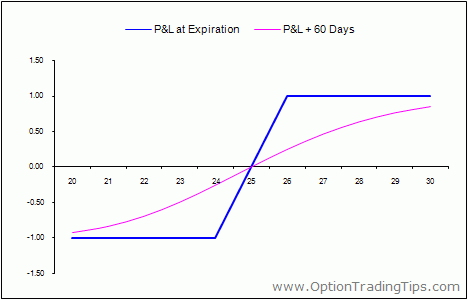
For those unfamiliar with the terms, a "bull call spread" is a spread composed of one long call, plus a short call of a higher strike. This is a limited risk, limited reward strategy; the payoff diagram of which looks something like this:

A stock collar is a position of long stock, a long put plus a short call. The interesting thing is that the payoff diagram at expiry of the options is similar the the one above.
Now a quick lesson in synthetics. A synthetic position is one which duplicates the risk profile of a natural position. So in our example above, the bull call spread can be viewed as the natural position. The stock collar, if the strikes prices are the same, can be viewed as a "synthetic" bull call spread, since the risk profile is identical. Both positions, if initiated at the same time, and held till expiry will have the same risk and the same reward. There are some non transparent and subtle differences between these two strategies which we'll get into in a minute.
The argument started when one group, lets call them "group O" made a case for collars being superior to verticals (i.e. bull call spreads) in all cases. viz:
The risk graph of a collar and bull call spread are the same, but that is where the similarities end.
You have a much better chance of making money over the long run with collars than bull call spreads because you are always in the position and the stock acts as a flotation device by which you remain at equilibrium.
The problem with a call spread (which is not like the collar) is that if you purchase an OTM call spread the stock can go up and you still lose money if the stock does not appreciate beyond the b/e point. Then when the options expire, you have to put on a new vertical call spread. Because of the run up in the stock which you may not have capitalized on, you will likely have to pay much more for the same vertical spread out the next month or move up a strike. If this keeps happening on a slowly drifting higher stock you could be chasing profits all the time without actualizing any. It is a non-fluid trade because of the starting and stopping effect of moving options around every month.
COLLAR FIXES THIS:
The collar is superior to the vertical because you will be in the stock at all times and do not run into the static fluctuations inherent in an option only strategy. Yes, you have options in the form of a short call and long put, but that is what you want with regard to the horizontal lines of the PNL or Risk Graph of this trade. It is the horizontal line of the stock with the collar that flows while the horizontal line on a vertical has to be moved every month which can disrupt profitability.
Conclusion:
Though the profit and loss graphs of a vertical spread look the same in any given month, they are drastically different when you compare spreads v. collars over several months (or longer). It is for this reason that I think the collar is a greatly superior trade than a vertical. It is why guys who are poor at picking market direction can make a fortune trading collars but have a more hit-or-miss track record with verticals. This is an important distinction!
The opposing group, let's call them group E, thought this was nonsense. Whether it is or not might require another 5o pages of WW4 to sort out lol.
However, having survived the conflagration, which spanned several bulletin boards and many countries, I have come to the following conclusions:
*Any talk of difference in the two strategies in rolling the short strike is nonsense, they are the SAME call. We can effectively strip away the short strike and this leaves us with a natural call and a synthetic call (long stock/long put) for the true comparison.
*There is a difference here in that we pay the cost of carry up front when we buy the natural, whereas the cost carry is "pay as you go" for the synthetic.
*So if the underlying takes a big hit early in the life of the strategy, we cop the additional loss of the cost of carry on the natural.
*"Dividends, capital returns and these types of situations can be detrimental with a bull call spread where the short call is at risk of assignment. The long call will not hedge the div if one is assigned on the short call the day before x-div, so that in itself can create a big difference in the profit/loss between the two strategies if the bull call is not managed properly under these types of conditions." (kudos to "sails")
*"As the interest component is usually around the risk free rate and margin lending is well above the risk free rate, There is an advantage to leverage at a lower interest rate." (kudos again to "sails")
Conclusion (so far): Neither is superior at inception. Obviously if you already hold the stock and you want that sort of risk profile, a collar is a shoe in. If not already holding stock, I personally would go for the bull call spread (if I wanted that risk profile)
Ultimately, the differences lie in the nuances in extreme circumstances, otherwise they are virtually equivalent. As we cannot predict extreme circumstances, the superior strategy for any given extreme, can only be decided in retrospect. My view is either strategy can be used with equal success. Some still don't see it that way.
Result: an uneasy truce. :)