Showing posts with label Vertical Spreads. Show all posts

17 August 2009

Synthetic Equivalence - What It Ain't.

I've posted a bit on synthetic equivalence a few time in recent months, both here on the blog and on some message boards. Some people have a few trouble with this concept even when proven mathematically, so thought I would talk a bit on what it is and what it isn't.

For what it is, I'll leave the explaining to Charles Cottle, from The Hidden Reality:

There is the raw (actual)position consisting of the exact options that contribute to an overall strategy. For every raw position there are a number of alternative positions called synthetic positions (synthetics). A synthetic position has the same risk profile as its raw position and achieves the same objectives.


What that means is that the risk profile of an option strategy can be duplicated via different combinations of options and/or stocks. A few examples:

A covered call is a synthetic naked short put
A married put is a synthetic long call
A collar is a synthetic vertical spread

There are dozens of combinations that can duplicate the risk profile of different combinations.

The problem seems to be that some people feel that the positions must me identical in every respect to be synthetically equivalent. The most common objection is that of different capital/margin requirements. - that if one position needed more money to trade than the other, they can't be synthetically equivalent.

One fellow didn't feel that a long call/short corresponding put wasn't synthetically equivalent to long stock, because he could get the option combo on margin, whereas the stock required the full investment of the value of the stock. That *may* be true for some traders. But it is certainly not true for others due to different margin rules, haircuts or whatever.

The logical extrapolation of that logic would be that stock bought on margin is not the same as stock bought for cash.

In any case, capital/margin requirements are not relevant to synthetic equivalence. What is relevant, it the risk profile... the payoff diagram adjusted for cost of carry and dividends if necessary.

Capital/Margin is not considered when looking at synthetic equivalence.

11 August 2009

Credit Spread Myths

So a few posts back I started on a bit of a rant on the BS being passed off as information on credit spreads and gave up about half way through. As the fashion for option bloggers is to do the odd video these days, I decided to finish the job in a video.

I've picked on the same article, because it encaspulates most of the nonsense out there in just two or three paragraphs and a few bullet points. I don't have anything to sell, so no need to be wary about any marketing at the end.


13 July 2009

Credit Spread Nonsense

In keeping with my current fetish for trying to bust a few nonsensical myths and mistruths with premium collection strategies, I guess I've turned my attention to credit spreads.

Look! Credit spreads are a good strategy, one good strategy, one of any number of good strategies. I use them when I think they are the right strategy to use. What makes me lose the will to live is the bullshit that emanates from ersatz experts and course spruikers.

N.B. I have nothing against education courses at all. There are a few good ones I'll never criticize, but they are outnumbered by some truly odious and dangerous programs inflicted on innocent neophyte option traders... usually at vast expense.

To subject (sent via email so unable to attribute) of my ire today, which resulted in a distinctly forehead shaped dent in my desk, behold:

The beauty of option trading is that it opens up a lot of alternative ways building wealth from the stock market. Recent events have shown that the "buy-and-hold" approach to stock trading carries substantial risk. With a volatile market, a safe "in-and-out" approach is much more desirable. Of all the option trading strategies available, trading credit spreads is by far the safest and simplest method. It has a risk profile significantly lower than stock trading, and it offers much better profit than any type of stock trading strategy around.

Selling credit spreads takes advantage of the fact that the value of any option declines as the expiry date of the option approaches. It does this particularly fast during the last 30 days of the life of the option. It has been said that 90% of option buyers lose their money. This means that those who sold the options to those unfortunate buyers win 90% of the time!

What are the advantages of credit spread trading?
  • It is short term - trades are typically less than 30 days in duration, and take advantage of short term trends in the market;
  • It is low risk - trades have a better than 90% of success - always! You know exactly what the risk, return and profit will be before you enter a trade - there is no guess work.
  • Profit is up front - a trader gets his profit immediately, and only needs to protect that profit for a short period;
  • Market fluctuations are mostly irrelevant. The market can continue its trend, stagnate, or even turn against you to a certain extent, and your profit is completely safe and untouchable.
  • Simple technical analysis - other options trading strategies (and stock trading) require intense fundamental and technical analysis, significant understanding of the market, and the ability to "beat the news". Selling Credit spreads needs a very simple trend analysis procedure, which should not take longer than 10 minutes a day, and the ability to plan for upcoming events such as earnings reports.
  • Time spent in monitoring the trade is very low;
  • Profits range between 5% and 20% per month, depending on how actively the spreads are traded. Compounded, this leads to significant growth in a profile. Starting with $1,000 and gaining a steady but sure 15% per month, you can get your first million dollars in four years, without deductions for ulcer treatment.
What do you need in order to start building wealth by selling credit spreads?
you need an account with an options trading broker such as Thinkorswim or OptionsXpress.
you need a minimum balance of $1,000, in order to cover margin requirements for selling credit spreads.
you need to be able to identify a trend in the market and in your chosen stock.
you need to be able to look ahead for predictable events such as earning reports and dividend payments.
you need about 15 minutes per week.
...and that's it!
You do not need nuclear physics degree in fundamental and technical analysis; you do not need to spend hours pouring over graphs and indicators; you do not need to go bald, get an ulcer or a heart condition; and you definitely do not need to pander to your obsessive compulsion to constantly monitor your trade, making fiddly adjustments on the way!

Selling credit spreads is an excellent method for those who are committed to a safe, steady approach to building wealth.

I sell credit spreads every month, and even when a very few trades have gone against me, I still build an average 15-20% growth on my portfolio each month.

Hallelujah! The Holy Grail found! Gold, Frankincense and Myrrh for all! If your still with me, indulge me in a point by point fisking:

The beauty of option trading is that it opens up a lot of alternative ways building wealth from the stock market.

A good start for the writer here, this is exactly the reason we option traders trade options rather than the underlying stocks. Unfortunately, it's all downhill from here.
Recent events have shown that the "buy-and-hold" approach to stock trading carries substantial risk.

Well, yes, but wait for the rest.

With a volatile market, a safe "in-and-out" approach is much more desirable.

Why is it more desirable? It might be for the author and it might be for me, but it might be the antithesis of what is desirable for somebody else, depending on innumerable factors.

Of all the option trading strategies available, trading credit spreads is by far the safest and simplest method.

How so? Simplest? So a two legged strategy is simpler than a simple bought option? Safest? How does he/she quantify safe? Considering that one can put their entire capital at risk in one trade, with some probabilty of a maximum loss, I violently disagree. Most strategies are safe if used safely, i.e. with proper position sizing. All strategies, including credit spreads, are unsafe if used with too much size/leverage.

It has a risk profile significantly lower than stock trading, and it offers much better profit than any type of stock trading strategy around.

This is about the point where my forehead first hit my desk with some velocity. Without going into mathematics and payoff diagrams, this is a truly pukeworthy statement. Much better profit? Credit spreads offer a "different" risk/reward/probability profile which may be better in certain circumstances but not others. Stock going sideways? Sure, give me a credit spread or related strategy. Stock about to go to the moon? I'll take the stock, or perhaps some call options thanks.

Selling credit spreads takes advantage of the fact that the value of any option declines as the expiry date of the option approaches. It does this particularly fast during the last 30 days of the life of the option.

This person has obviously never heard of delta/gamma. True, extrinsic value, in simplistic terms, declines, but what about intrinsic value? I want to ask this person if he/she thinks the value of the put option he/she just sold is going to be worth less if $10 in the money at expiry.

It has been said that 90% of option buyers lose their money. This means that those who sold the options to those unfortunate buyers win 90% of the time!

Just disingenuous bullshit. Even the standard myth only says 80%. The truth is somewhat different and more complex. For another post maybe.

It is short term - trades are typically less than 30 days in duration, and take advantage of short term trends in the market;

Yes short term, but the preceding statement says this person is trading OTM credit spreads. If I want to trade short term trends, I'll pick an entirely different strategy. OTM Credit spreads are best for non-trends or slow trends. If you're trying to trade a trend and still want a vertical spread, go an ATM debit spread.

It is low risk - trades have a better than 90% of success - always! You know exactly what the risk, return and profit will be before you enter a trade - there is no guess work.

Well I don't know about low risk, there is a higher probability, but also a very low reward compared to the outright risk. Again that's OK, if it suits your view. But a credit spread constructed with 90% theoretical probability is going to be extremely skinny on the nett credit. As far as "always", a truly risible statement.

Profit is up front - a trader gets his profit immediately, and only needs to protect that profit for a short period;

Oh brother!! The old credit is better than a debit fallacy. I wonder if this person ever tried to spend that up front profit? I wonder if he/she ever looked at their margin statement. I think these are best constructed as credit spread, but for completely different reasons than the up front credit. The credit is *irrelevent*. It is the positive theta one is trying to trade here while hoping not to get crunched by the other greeks. Positive theta, AKA premium collection, can still be acheived with an initial debit.

Market fluctuations are mostly irrelevant. The market can continue its trend, stagnate, or even turn against you to a certain extent, and your profit is completely safe and untouchable.

This one is kind of half true. Provided that the underlying doesn't close ITM on the sold option, you keep the credit. In the intervening period however, you can be deep in a hole if the stock is moving against you. The profit is most certainly not safe as you are then in a position of hope. An exit or adjustment is going to cost.

Simple technical analysis - other options trading strategies (and stock trading) require intense fundamental and technical analysis, significant understanding of the market, and the ability to "beat the news". Selling Credit spreads needs a very simple trend analysis procedure, which should not take longer than 10 minutes a day, and the ability to plan for upcoming events such as earnings reports.

What can I say.... this is just nonsense. A simple approach may work, indeed it does. But a simple laissez faire TA approach is not going to give you 90% probability spreads.

Profits range between 5% and 20% per month, depending on how actively the spreads are traded. Compounded, this leads to significant growth in a profile. Starting with $1,000 and gaining a steady but sure 15% per month, you can get your first million dollars in four years, without deductions for ulcer treatment.

[sigh] The BS just doesn't stop! I'm weary, I've had enough of this. Maybe I'll continue this once I've recovered from concussion


30 June 2009

Put Spreads - How to Blow Yourself Up In One Easy Lesson

Original Content Sigma Options

++++++++++

My last few posts have been concentrating of naked puts, the main point I've been trying to get across is that they no more risky than anything else, less so, in fact. But we've seen that they can indeed be a weapon of mass wealth destruction if the trader uses inappropriate levels of leverage.

See:


A suggestion that came up as a safer alternative for a straight out premium collection trade is the bull put spread. In principle, I agreed with the suggestion, but with a few caveats.

  1. Proper money management/position sizing is used.
  2. Reward versus risk is commensurate with the probability of win/loss.
  3. Be careful of correlation with multiple positions.

Even though the bull put spread is perceived as a safer strategy than naked puts, it is not necessarily so, if our old friend leverage is used inappropriately. I would argue that bull put spreads may even be more dangerous than naked puts, depending on the margin requirements of individual jurisdictions and brokerages.

There was an option "education" firm (and I use that term very loosely) in Australia promoting bull put spreads as a panacea for wealth building. The chap even gave it a new name... his name - The ######### Strategy (I have no wish to publicize this rubbish) - how's that for marketing nonsense?

I don't have a challenge with bull puts, 'cept that they aren't appropriate at all times. To borrow a point from Ecclesiastes 3, there is a time for every strategy. The most odious feature of our ersatz options guru is the money management and position sizing algorithm whereby most, if not all of the trader's capital is put at risk in the market. This is spread across four or more positions, but the dearth of tradeable options on the Australian market means there is a very high degree of correlation in optionable stocks.

Every boat rises with the tide, as neophyte bull put traders thought that the Holy Grail had been found at last. That is until the arrival of last year's bear market. Those slow to react, in denial or too green to know what to do next were completely wiped out.

Once again, the fault is not the strategy, the fault is leverage... and fighting the tape.


01 January 2007

The Great Vertical vs. Collar Debate

Actually, it was more of an argument than a debate...

Actually, is was more like WW3 lol. In any case, it was an episode in which a whole bunch of option traders and ersatz experts behaved very badly and it centered around the synthetic relationship between a bull call spread and a stock collar. Luckily, there was an occasional snippet of options theory plus the odd piece of mathematics which tied all the acrimony around the central theme.

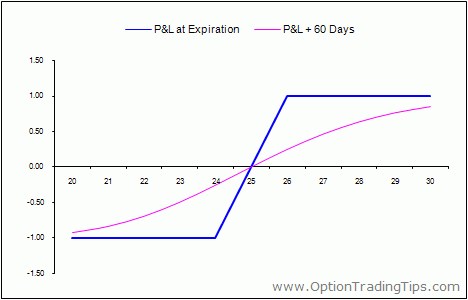
For those unfamiliar with the terms, a "bull call spread" is a spread composed of one long call, plus a short call of a higher strike. This is a limited risk, limited reward strategy; the payoff diagram of which looks something like this:


A stock collar is a position of long stock, a long put plus a short call. The interesting thing is that the payoff diagram at expiry of the options is similar the the one above.

Now a quick lesson in synthetics. A synthetic position is one which duplicates the risk profile of a natural position. So in our example above, the bull call spread can be viewed as the natural position. The stock collar, if the strikes prices are the same, can be viewed as a "synthetic" bull call spread, since the risk profile is identical. Both positions, if initiated at the same time, and held till expiry will have the same risk and the same reward. There are some non transparent and subtle differences between these two strategies which we'll get into in a minute.

The argument started when one group, lets call them "group O" made a case for collars being superior to verticals (i.e. bull call spreads) in all cases. viz:

The risk graph of a collar and bull call spread are the same, but that is where the similarities end.
You have a much better chance of making money over the long run with collars than bull call spreads because you are always in the position and the stock acts as a flotation device by which you remain at equilibrium.

The problem with a call spread (which is not like the collar) is that if you purchase an OTM call spread the stock can go up and you still lose money if the stock does not appreciate beyond the b/e point. Then when the options expire, you have to put on a new vertical call spread. Because of the run up in the stock which you may not have capitalized on, you will likely have to pay much more for the same vertical spread out the next month or move up a strike. If this keeps happening on a slowly drifting higher stock you could be chasing profits all the time without actualizing any. It is a non-fluid trade because of the starting and stopping effect of moving options around every month.

COLLAR FIXES THIS:
The collar is superior to the vertical because you will be in the stock at all times and do not run into the static fluctuations inherent in an option only strategy. Yes, you have options in the form of a short call and long put, but that is what you want with regard to the horizontal lines of the PNL or Risk Graph of this trade. It is the horizontal line of the stock with the collar that flows while the horizontal line on a vertical has to be moved every month which can disrupt profitability.

Conclusion:
Though the profit and loss graphs of a vertical spread look the same in any given month, they are drastically different when you compare spreads v. collars over several months (or longer). It is for this reason that I think the collar is a greatly superior trade than a vertical. It is why guys who are poor at picking market direction can make a fortune trading collars but have a more hit-or-miss track record with verticals. This is an important distinction!


The opposing group, let's call them group E, thought this was nonsense. Whether it is or not might require another 5o pages of WW4 to sort out lol.

However, having survived the conflagration, which spanned several bulletin boards and many countries, I have come to the following conclusions:

*Any talk of difference in the two strategies in rolling the short strike is nonsense, they are the SAME call. We can effectively strip away the short strike and this leaves us with a natural call and a synthetic call (long stock/long put) for the true comparison.

*There is a difference here in that we pay the cost of carry up front when we buy the natural, whereas the cost carry is "pay as you go" for the synthetic.

*So if the underlying takes a big hit early in the life of the strategy, we cop the additional loss of the cost of carry on the natural.

*"Dividends, capital returns and these types of situations can be detrimental with a bull call spread where the short call is at risk of assignment. The long call will not hedge the div if one is assigned on the short call the day before x-div, so that in itself can create a big difference in the profit/loss between the two strategies if the bull call is not managed properly under these types of conditions." (kudos to "sails")

*"As the interest component is usually around the risk free rate and margin lending is well above the risk free rate, There is an advantage to leverage at a lower interest rate." (kudos again to "sails")

Conclusion (so far): Neither is superior at inception. Obviously if you already hold the stock and you want that sort of risk profile, a collar is a shoe in. If not already holding stock, I personally would go for the bull call spread (if I wanted that risk profile)

Ultimately, the differences lie in the nuances in extreme circumstances, otherwise they are virtually equivalent. As we cannot predict extreme circumstances, the superior strategy for any given extreme, can only be decided in retrospect. My view is either strategy can be used with equal success. Some still don't see it that way.

Result: an uneasy truce. :)