Showing posts with label Strategies. Show all posts

01 July 2009

Covered Calls and Naked Puts - Same Only Different

Original Content Sigma Options

++++++++++

We all know that naked puts and covered calls are synthetically equivalent... well I hope we all know by now, and we know that a buy write IS a covered call.

My thesis today is that they all may be quite different, not in risk profile, but in the psychology these strategies are a subject of.

Firstly the difference between a covered call and a buy write. Of course there is no official difference, it's long stock and short a call no matter which name you use, but I think there is a difference of inception, the nomenclature different according to the goal of the trader. I think of a buy write as when a stock is bought with the call written at the same time. A covered call I think of as a call written over stock already owned, perhaps for some considerable length of time.

A buy write is entered as a trade to collect the premium (Here I am speaking of general practice, not my practice) and the buy writer is hoping that the stock goes up and is called away. Of course a written put can be used instead, but there are a few reason why the trader doesn't use the naked put. He may have done one of "those" courses. He may not know about synthetic equivalency. His muppet of a broker may not allow him to trade naked puts. This is the sort of trader that scans for high IVs looking for maximum premium (for better or for worse), but he usually doesn't want to keep the stock.

The covered call trader on the other hand, already owns the stock. He probably doesn't want his stock called away, particularly if he has a low cost base and doesn't want a capital gains tax event. As such he is probably writing the call to partially hedge and/or derive some extra income from the premium. His stock is going sideways or perhaps on what he hopes is a short term decline. If the call goes in the money, he is more likely to trade out of the call rather than have his stock assigned.

Please note that these are personal definitions and may not reflects other's thinking.

The naked put trader generally has one of two goals. He either want to just collect premium, so is like our buy writer, or he is writing puts he hopes will end up in the money and wants to be assigned the stock. This second type of naked put trader is more akin, but slightly different to our covered call trader. He is used the puts as part of an overall investment strategy and not really a trader.

All of the above traders may select different strikes and expiries depending on what his ultimate goal is.

So yes, all have the identical payoff diagram when the strike price and expiry are the same, but there are different reasons and psychology that dictate different approaches within the same group of strategies.

30 June 2009

Put Spreads - How to Blow Yourself Up In One Easy Lesson

Original Content Sigma Options

++++++++++

My last few posts have been concentrating of naked puts, the main point I've been trying to get across is that they no more risky than anything else, less so, in fact. But we've seen that they can indeed be a weapon of mass wealth destruction if the trader uses inappropriate levels of leverage.

See:


A suggestion that came up as a safer alternative for a straight out premium collection trade is the bull put spread. In principle, I agreed with the suggestion, but with a few caveats.

  1. Proper money management/position sizing is used.
  2. Reward versus risk is commensurate with the probability of win/loss.
  3. Be careful of correlation with multiple positions.

Even though the bull put spread is perceived as a safer strategy than naked puts, it is not necessarily so, if our old friend leverage is used inappropriately. I would argue that bull put spreads may even be more dangerous than naked puts, depending on the margin requirements of individual jurisdictions and brokerages.

There was an option "education" firm (and I use that term very loosely) in Australia promoting bull put spreads as a panacea for wealth building. The chap even gave it a new name... his name - The ######### Strategy (I have no wish to publicize this rubbish) - how's that for marketing nonsense?

I don't have a challenge with bull puts, 'cept that they aren't appropriate at all times. To borrow a point from Ecclesiastes 3, there is a time for every strategy. The most odious feature of our ersatz options guru is the money management and position sizing algorithm whereby most, if not all of the trader's capital is put at risk in the market. This is spread across four or more positions, but the dearth of tradeable options on the Australian market means there is a very high degree of correlation in optionable stocks.

Every boat rises with the tide, as neophyte bull put traders thought that the Holy Grail had been found at last. That is until the arrival of last year's bear market. Those slow to react, in denial or too green to know what to do next were completely wiped out.

Once again, the fault is not the strategy, the fault is leverage... and fighting the tape.


10 March 2007

Writing Commodity Options

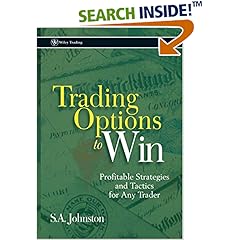
A few of you still reading this infrequent drivvle of mine have mentioned the writing of options over commodity futures. I don't have enough experience with commodity options to be authoritative, but I have read what I think is an excellent book on the topic and it deals extensively with written options on futures.

This book is written by a bloke called Stuie Johnston. Some have criticized it for its conversational and irreverent writing style, but I found it not only occasionally hilarious, but very good at setting out a philosophy and methodology for premium collection on commodity futures.

Be prepared for a few statistics and discussion on seasonality... and especially what Stu refers to as NON-seasonal trades.

Check it out

He also runs a very good seasonal trading database site that if/when I have a crack at this, I will definitely subscribe to. www.timeandtiming.com (no financial connection blah blah)

05 March 2007

What You Didn't Know About Time Decay

Time decay is known by the greek word "theta" and what everybody knows about theta is that it accelerates in the last month of the options life, losing a substantial whack of its value in the last few days.

In every option text I've ever read, theta is universally depicted by a graph that is something like the following:


This is a graph of the time value of the last 90 days of an ATM option. As you can see, the rate of decay is more or less linear up until the last 30 days, whereupon it starts to decay at an accelerating rate, losing the remaining value very quickly in the last few days.

This is proof that if you short options you should choose options with about a month remaining because that is when most of the decay is.

Or is it?

The above is certainly true for At The Money options. But what about Out of The Money options? What the textbooks don't tell you is that for an option that is somewhat OTM (or somewhat In The Money for that matter) is that the above scenario is not quite true. The characteristics of theta change, the further we go OTM or ITM.

Lets look at a theta graph for an option that is somewhat OTM:


Lo! It seems in this instance, that theta does not accelerate in the final 30 days at all, but rather DECELERATES.

If we are short OTM options we will collect more theta by writing expiry further out... 60 or perhaps 90 days and wind them up before the last month.

This is where "options education" can sometimes be erroneous and it pays to observe, notice things, play around with your strategy modeler and/or excel spreadsheet and really become intimate with these option concepts. It does pay.