Showing posts with label Option Concepts. Show all posts

21 September 2009

Bloomberg Option Blooper

There are no end of erroneous statements regarding options that appear in financial publications. Today I'm going to pick on an article in Bloomberg, because I just happened to do something I don't often do... and that is read Bloomberg. (Nothing worse about Bloomberg than other Wall Street Cheerleaders, I don't often read much of any of them).


Oil Options Hit Highs as Verleger Predicts 44% Plunge

Sept. 21 (Bloomberg) -- Oil traders are paying more than ever in the options market to protect against a plunge in crude prices.

Oil options are something I follow pretty closely, so fearing a volatility spike that I had missed, I immediately pulled up $OVX (The VIX of oil options)


Hmmmmm IV near recent lows, no spike there. What could our B'berg author be on about here. Reading further:

The gap between prices of options betting on a decline and those that would profit from a rise in oil widened to a record 10 percentage points, according to five years of data compiled by Banc of America Securities-Merrill Lynch...
...Options granting the right to sell, or put, oil in December below current prices have a so-called implied volatility of 54.3 percent, compared with 43.3 percent for the equivalent options to buy, or call, data from the New York Mercantile Exchange show.

What's this? The arbitrage opportunity of the century? As I pulled up the option chain for December crude, I was multitasking and transferring every cent of spare cash in my trading account for mountains of reversal margin. Alas, I was disappointed as both ATM calls and puts were priced equally in terms of volatility.

What the f*** were they on about?

The subtle clue is what I have retrospectively bolded in the above quote. The author was comparing the IV of WOTM puts to WOTM calls. This is nothing more than a downside price skew. Skew is common in all sorts of markets; in fact it would be a little unusual for a market not to have some degree of skew to one side or another.

It's true that event sensitive commodities usually have skew to the upside and therefore skew to the downside in oil is noteworthy. The hypothesis that oil probably will experience some downside pressure is a fair one. But I wish they would call a spade a spade rather than dishing out erroneous bullshit on on options like this article has. Options are confusing enough for the neophyte, without inaccuracies from supposedly authoritative sources.

Give yourself an uppercut Bloomberg.

18 September 2009

Options Spuikers Under The Spotlight

Choice Magazine which is a consumer magazine down in Australia has done a bit of a spiel on options trading seminars, featuring "The Big O" and a local spruiker. Read the article here.

They took quite an even handed approach, but there are some interesting quotes:

One company, Optionetics, says if you don’t make 300% on your tuition fee in six months you’ll get your money back. Another, Traders Circle, recently said at a free seminar that if you start with just $4000, its options “mentoring program”, “recipe for success” and trading recommendations will teach you how to earn $1000 per month for the rest of your life.

I suppose enough has been said around the traps about Optionetics refund policy, but Traders Circle claiming 25% per month? For life? Hmmmmmm. Excuse me a second while burst out laughing.

We attended free seminars and spoke to other experts to find out if options are really the best way to profit from volatile market conditions. We found options to be highly speculative, with a very real chance you’ll lose everything you invest. We also uncovered some dubious get-rich-quick claims that downplay these risks.

The bit in blue might not be necessarily true, but Choice probably couldn't help arriving at that conclusion from what was presented. Re the green bit - Indeed.

We contacted Traders Circle to confirm what we’d heard at their free seminars. They clarified that profits are before costs described in the company's financial services guide including trading fees (up to $82.50 per trade), education fees ($7000-$13,000) and monthly subscriptions ($349), and before losses from unsuccessful trades.

Holy Shit!!

While the risks of options trading are described and the company (Optionetics) proposes to teach people how to set predetermined entry and exit points for trades as a way to cut their losses when markets move the wrong way, there’s far less focus on the losses that customers must also be experiencing.

We’re not the only ones sceptical about the potential profit claims. “While it may be possible for such returns to be achieved, it would only result from adopting risky strategies,” says the SDIA’s Doug Clark. “The risk of loss from trading in options can be substantial. In all investments, high returns usually mean high risk. A good options adviser is invaluable to help you understand the market and give suitable advice.”

Rod Peters of ABN AMRO Morgans uses options for private clients, but mainly for capital preservation and to earn an additional income, rather than to speculate on big profits. He says 1.5% profit per month, or even double digit figures in a year, would be “a phenomenal return” from options, even for someone prepared to accept some investment risk. “I don’t believe the higher returns being quoted by these options education companies are sustainable,” he says. “Any astute investor would realise that to achieve those returns you need to get lucky, take extreme risks, or both.”
Good comments.

My biggest eye rolling moments come from the "it only takes 20 minutes a day" assertions. Here's what one client had to say:

"I attended an options seminar in 2002 and, while I thoroughly enjoyed the program and felt I learnt a lot, I believe that the instructors give a false impression in relation to both the amount of time and effort required to trade properly. It was stated during the seminar that, provided we put alerts and stops on our buys, we would need to spend no more than 20 minutes per day to trade successfully. However, I do not believe this to be true and feel, particularly if you are working in a full time position, that it is simply not possible to monitor your trades effectively enough to be successful." Fran
Lastly, something anyone that's been around options longer than 5 minutes knows about these seminars:

"The biggest problem I've found with a lot of these training companies that offer 'free' seminars is that the courses they spruik are expensive (probably to cover the HUGE of marketing that they must incur) and the content of the free seminar is purely a marketing vehicle to build hype for the product." - Paul
It not a bad article and a good read. It bags out these companies with reasonably accurate information, but unfortunately perpetuates a few of the pernicious myths about options trading if someone was seriously considering going about it the right way. Lots of good quotes to pull out of it too.

24 August 2009

Futures Options - Part 3

Judging by my site stats since starting on futures options, it doesn't seem like there is a lot of interest in them. That's a bit of a shame in my opinion, because there are some great opportunities to trade in the futures/commodities markets.

While there is nothing at all wrong with stock options and I will continue to trade them, commodity options can be far more suitable for some investors/traders, particularly if you like writing options.

The seasonal tendencies in commodity markets offer some unique opportunities, not just for speculating on direction via direct futures and/or long options and option spreads, but I think the most reliably profitable trades are the so-called "non-seasonal" option write as described in Stuart Johnston's "Trading Options to Win".

This is basically writing options on the opposite side of a seasonal tendency, or even just a seasonal non-tendency. This is a trade that has history and statistics on it's side and with discipline, is an excellent way to trade.

One of these to follow in the near future that I have alludes to already on the blog, is the seasonal bull in gold which begins around the 9th of Sept and continues to the first week in October.

I'll wrap up this "difference between stock and futures options" theme with a couple more points and then it's DYOR.

Tick Size

Each commodity future has its own minimum tick size that will relates to the price per bushel/tonne/bale/whatever and they are all different. As an example, the grain complex is quotes in cents per bushel (contract size is 5,000 bushels) with a minimum tick size of 1/4 of a cent. This means each cent movement on a contact of , say corn, is worth $50.00, while the minimum tick size is $12.50.

One would think the options would be quoted the same way. Nope. Grain options have a minimum tick size of 1/8 of a cent, not 1/4 cent. No big deal, but something to be aware of and something to research at the relevant exchange's site before trading them.

Margin

If you like writing options, you can leave Reg T behind with futures option. Futures options margins are calculated using a ludicrously complex algorithm called SPAN, which is short for
Standard Portfolio ANalysis of Risk and better known to stock option traders as portfolio margin.

As a general guide, short option premiums on ATM or OTM options will generally be less than their corresponding futures margins, which is quite generous.

There's enough there for folks to be aware that there are significant differences between stock and futures options and my best advice is to aways refer to the exchanges website to be sure of contract specs and expiry.


19 August 2009

Future Options - A Bit Different

With Liberty trading Group running all over the shop promoting the writing of commodity futures options, I thought it would be a good time to highlight some of the differences between futures options and stock options.

This first post is on pricing.

Anyone who looks at payoff diagrams will notice a slight difference in how futures options are priced. The most obvious diagram to look at is a straight out ATM long call and the corresponding long put.

Supposing you have two instruments with all things being identical, i.e. all inputs into the model are the same, but one is a futures option and the other a stock option. You will notice that stock option calls are more expensive than the futures option call. Likewise, the stock option puts will be cheaper than the futures option puts.

Also, if exactly at the money, the futures options call and put prices will be virtually identical.

Furthermore, again if exactly at the money, you will notice that stock option calls will have a delta of greater than 0.5, with the negative delta of puts less than 0.5 (the absolute values of both should add up to 1), whereas the futures option will be very much closer to, if not exactly 0.5 each.

The reason for this is the cost of carry priced into the options. Stock options make the assumption that someone is holding stock and is entitled to be paid carrying costs in lieu of risk free interest, whereas a futures option is an option on another derivative contract. This means that carrying costs priced into futures options are negligible.

There are a few other differences which I'll be going over ion the next few days - stay tuned

17 August 2009

Synthetic Equivalence - What It Ain't.

I've posted a bit on synthetic equivalence a few time in recent months, both here on the blog and on some message boards. Some people have a few trouble with this concept even when proven mathematically, so thought I would talk a bit on what it is and what it isn't.

For what it is, I'll leave the explaining to Charles Cottle, from The Hidden Reality:

There is the raw (actual)position consisting of the exact options that contribute to an overall strategy. For every raw position there are a number of alternative positions called synthetic positions (synthetics). A synthetic position has the same risk profile as its raw position and achieves the same objectives.


What that means is that the risk profile of an option strategy can be duplicated via different combinations of options and/or stocks. A few examples:

A covered call is a synthetic naked short put
A married put is a synthetic long call
A collar is a synthetic vertical spread

There are dozens of combinations that can duplicate the risk profile of different combinations.

The problem seems to be that some people feel that the positions must me identical in every respect to be synthetically equivalent. The most common objection is that of different capital/margin requirements. - that if one position needed more money to trade than the other, they can't be synthetically equivalent.

One fellow didn't feel that a long call/short corresponding put wasn't synthetically equivalent to long stock, because he could get the option combo on margin, whereas the stock required the full investment of the value of the stock. That *may* be true for some traders. But it is certainly not true for others due to different margin rules, haircuts or whatever.

The logical extrapolation of that logic would be that stock bought on margin is not the same as stock bought for cash.

In any case, capital/margin requirements are not relevant to synthetic equivalence. What is relevant, it the risk profile... the payoff diagram adjusted for cost of carry and dividends if necessary.

Capital/Margin is not considered when looking at synthetic equivalence.

11 August 2009

Credit Spread Myths

So a few posts back I started on a bit of a rant on the BS being passed off as information on credit spreads and gave up about half way through. As the fashion for option bloggers is to do the odd video these days, I decided to finish the job in a video.

I've picked on the same article, because it encaspulates most of the nonsense out there in just two or three paragraphs and a few bullet points. I don't have anything to sell, so no need to be wary about any marketing at the end.


07 August 2009

Volatility? What Volatility?

In option land, volatility has a specific mathematical definition and is used in the various pricing models (Black Scholes et al). That definition is as follows - the annualized standard deviation of logarithmic daily change in price. I have highlighted "daily" because that's what it measures, the daily change of price.

Option volatility takes no account of the trendiness of the underlying instrument however.

Let say instrument (a) moves 1% up and 1% down alternately for 20 days in a row, but instrument (b) moves up 0.5% every day for twenty days. Instrument (a) finishes very close to where it started, hardly any nett movement at all, yet (b) is up over 10% higher after the 20 days.

According to the option volatility formula, the volatility measured over this time frame is much higher for (a) than for (b).

But depending on your precise option positions (b) could probably *feel* a lot more volatile than (a).

This is the feeling some may be having at the moment if trading delta neutral strategies on index options (or just about any stock option actually). Realized volatilities have been trending down for months, with 20 day historical volatility sitting at just ~16% as I write. Yet anyone with short gamma wing spreads or (gulp) short strangles is going to be *feeling* like they are in a volatile market.

Well actually, we are, if you use a different measure of volatility.

Plain old standard deviation, measures the deviation from the mean (and as used in Bollinger Bands) over a set time frame tells a different story. While it has nothing to do with option pricing, it does show how much price is moving around or a longer period of time.

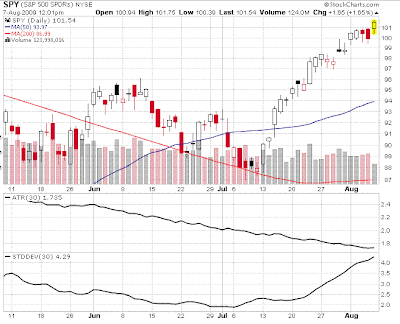
Check out the chart below (NB Stockcharts doesn't have HV as used in option pricing models, but Average True Range is used a proxy, as it also measures the daily range): Over the last three months 30 day ATR has gradually been trending downwards, mimicking HV as use in OPMs, yet 30 day standard deviation is at a high over the time period.


This is telling us what we already know, that the Indices have been flying in one direction. Volatility over a period of time IS in fact high as measured by standard deviation, even though volatility of daily changes has been declining.

It's another dimension to volatility that we retail traders probably need to throw into the mix when making volatility projections. For us, option volatility is important for pricing, but may not tell the whole story when analysing potential trades.

06 August 2009

Covered Calls - Naked Puts Redux

About a month ago, I was opining opining that though covered calls and naked puts are synthetic equivalents, there may be valid structural or psychological reasons why a trader might use one over the other.

It might not surprise many that I am impressed by my own profundity in that discussion ;). *Some* other arguments on the merits of one over the other leave me underwhelmed however, most particularly when those arguments are chockers full of non-sequiturs, half truths and plain old BS. These of course are all over the place in Option Land, but I'll pick on a recent article published by an option book vendor.

In the article, the author recognised the synthetic equivalency of covered calls and naked puts (rare), but argues the superiority of CCs based on a load of old cobblers, to wit:

Here are the reasons I prefer covered call writing to naked put selling:
1- Many brokerages want the assurance to know that you have the ability to purchase the shares you are obligated to buy when selling the put. Therefore, they will require you to have an adequate amount of cash in your account to cover such an event. You will then have sold a cash-secured put and set aside the same amount of cash as the CC seller.

I don't see this as a disadvantage at all if the goal is conservative premium collection. As the author acknowledges, capital usage is the same. Therefore, there is no valid reason on this point to prefer covered calls.

2- The seller of a covered call captures all dividends distributed by the underlying corporation, the put seller does not. We’re not talking about a huge windfall here, but the cash is better in our pockets than someone else’s.

Just plain incorrect. Option pricing takes into account any pending dividend and option pricing cum-dividend and ex-dividend account for them. If you have a covered call position, the call premium will be cheaper to the tune of the dividend amount. You get the dividend via the stock, but you lose it via less call premium. I have an article on the effects of dividends for further information.

3- Selling covered calls allows the investor more flexibility. The most profit a naked put seller can generate is the premium on the option sale. A covered call writer can profit from the option premium PLUS additional share appreciation if an out-of-the-money strike is sold. That choice is available to the covered call writer but not to the naked put seller.

There is still no difference in payoff. If an OTM call is written, the *corresponding* ITM naked put can also be written, again with the same payoff diagram as the OTM covered call. Synthetic equivalence is maintained no matter what the strike price.

4- Early assignment is not an issue for CC writers because the option premium is not affected and possible additional upside appreciation is incorporated into your profits if an O-T-M strike was sold. For naked put sellers, early assignment could be a disaster. Imagine a stock gapping down, and the stock “put” to us at the $30 strike. The stock is plummeting and heading for the teens! The put seller wants to sell the stock before it loses more ground but perhaps the shares haven’t even hit his account yet. He may have to wait until the next day to sell the shares. One way of getting around this issue is to sell the shares short (selling before actually owning them). The problem with this solution is that average... investors will have a difficult time getting “shorting privileges” from their brokerage firm and may lack the sophistication necessary to manage such situations. Besides, who needs the headaches?

There are a couple of points here:

a) It's true that the naked put might be assigned early if there is zero extrinsic value, however the short put will have a delta of +1, or very close to it, and will be trading like the stock anyway. This will put the trader in a position of a substantial open loss for sure, but the author neglects to inform the reader that the covered call will be in the identical position of a large open loss. Once again, the positions will be the same.

b) The suggested response of shorting stock is incorrect for the stated goal of exiting the position, as you don't know if and/or when you will be assigned. You may just be flipping your deltas and have an open synthetic short call. That's not what the author intended. There is no law that says you have to hold the put till expiry or assignment. The best response if you want to exit the trade before possibly being assigned is just buy back the written put.

5- Those interested in option investing in tax sheltered accounts, will have an easier time establishing such accounts using covered call writing than any other form of options trading.

This isn't my field, but I am led to believe that cash covered naked puts are permissable in such tax sheltered accounts.

If people really want to trade covered calls over naked puts, fine, there may be valid reasons as I stated in my earlier article. No skin off my nose, but let's not justify it with misinformation and bullshit.

31 July 2009

Conciousness vs Heuristics

In my previous post I discussed the competency scale used across a number of fields. The Ducster took issue with the term "unconscious".
From sigmaoptions, this post appeared discussing mental competencies. In a first part response, I’ll look at the Greeks component. In the second, I’ll consider the actual neurological pathways involved, and why in this example, unconscious is a misnomer.

While knowing what the term is getting at, I agree it is a misnomer; in the field of options trading anyway.

He suggests that the advanced options trader is in fact utilizing some form of heuristic reasoning rather than being "unconcious". That's probably more accurate, but it sure messes with the poetry of the "unconscious incompetent => unconscious competent" hypothesis.

So how to rejig it to incorporate "heuristic"? I can't think of anything that flows and describes the progression of competency nearly so well.

Suggestions welcome.


30 July 2009

Options and the Unconscious Competent

In other technical fields, I often heard of experts speak of the phases of skill progression from novice to expert, invariably stated as having four phases as below:
  1. Unconscious Incompetent
  2. Conscious Incompetent
  3. Conscious Competent
  4. Unconscious Competent
It's a fancy way of saying that you progress from an idiot, to knowing what you're doing without thinking. The unconscious competent is that individual that acts and reacts from second nature without having to think first. A kung fu master has hundreds of complicated techniques as his disposal that are second nature, due to thousands upon thousands of hours of practice. A master tradesman can be thinking about the hot looking woman that just walked past while he works; he is creating his work without thinking about it.

(N.B. I use the male gender generically and of course include females in this discussion)

Options trading is of course no different and it is the aim of any non-delusional individual to progress to the Unconscious Competent stage; just knowing what to do at any point, quickly, without an over reliance on software, calculators and suchlike.

The unconscious competent can have been in such a state for so long, that he no longer realizes what knowledge he is actually using.

An illustration of this point came up on a discussion forum recently. The question was asked, can you be successful without regard to the Greeks? Various points of view were put forth, but the one that interested me was from an ex-institutional trader with decades of high level experience. He thought that Greeks were not necessary for simple directional strategies.

I questioned whether he in fact had a mental map of option pricing that was so ingrained, that perhaps had a "picture" of the Greeks that he used without thinking about it, even with simple strategies. At first he didn't think so, but later reversed that opinion and agreed.

That man is an unconscious competent. Options trading is just second nature, to the point that he doesn't even have to think about it. This is the state all will aspire to and achieve given the correct knowledge/education. This is actually easier said than done as there is soooo much erroneous information and truly worthless (and very bloomin' expensive) options education programs out there.

Getting to the Conscious Competent stage for a retail trader is harder than many imagine, that is, getting the correct grounding in options theory and pricing. So many crash and burn from being taught BS.

Every options education program, whether in book form or CD/Internet course needs to be marketed in order to attract clients; and the trainers will require remuneration for their efforts.

But how does the options neophyte sort the good from the bad and the truly ugly?

Even good programs will indulge in a certain level of hype. This is the reality of marketing, "warts and all" reality just won't sell well. But on the other hand, what seems to good to be true, probably is. This is the sort of thing I have bagging out recently, the total BS claims and totally erroneous and inaccurate, even mischievously outrageous claims.

I guess it boils down to avoiding the worst of the hype and being somewhat skeptical, perhaps even cynical when evaluating a potential information vendor.

Be careful out there. Marketers are master psychologists (unconscious competents) and work on your base emotions rather than your intellect. Some of the worst programs are the most absolutely taleted marketers, because they appeal to those most powerful of financial market emotions, fear and greed.


25 July 2009

American vs Euro Double Take

As I trawl around the options universe I see many statements from the erroneous to the downright dishonest. Occasionally there are statements from ersatz options "experts" that even make me do a double take, so stunning are they in their cretinous ignorance.

Behold the latest example, from someone selling information, producing videos etc:

American vs. European style options:

American style options such as OEX or SPY can be traded anytime. European style options can not be closed until their expiration date. I prefer to trade American style options since I can buy and sell them out when I want.

LMAO

Of course European style options can be traded into and out of, anytime, just as American style options can. Jesus! We ALL know that one don't we? (For the newbies reading this, American or European style refers to when options can be exercised, not whether they can be closed out or not.)

Further down the page, we are served up this little beauty, in big bold type:

Turn $1000 into $124,000 in One Year!!!

Where do I sign?

23 July 2009

VIX Options Weirdness

I don't trade VIX options, but I've shown some pretty wacky disparities between call and put IVs. I thought there had to be an explanation, because it just wasn't credible that such huge differences weren't arbed away.

Dean Mouscher has the answer in a 16 minute video on the subject.

If you are trading these, or might at some point in the future, this is a must view.

20 July 2009

Probability is Probably Improbable

The Ducster has brought an interesting theme in the whole probability/expectancy conundrum that has been bouncing around the blogosphere of late:

Probabilities, or frequencies that are calculated via Black-Scholes, Binominal Tree or even the more esoteric methodology of GARCH, all essentially utilise a Gaussian distribution of stock prices in their volatility calculations.

This as the old saw notes, generally works well, until it doesn’t. <<Read>>

Essentially, probabilities are calculated by one or another model using a sample past data. This is a problem. As we know, in real life, stock market distributions do not really adhere to distribution assumptions of the various models - Black Scholes, Binomial Tree et al. There are models that are allegedly better, but not in common use. More particularly, the data sample used, or even volatility projections implied by option price may bear no relation to future volatility as it is realized. Also, statistical probabilities change as events unfold.

Two days can change the statistical landscape the trader has used to place a trade altogether.

The whole problem with using a model is... well, it's just a model...

...and models fail.

So when option traders make assumptions about probabilities and take risks based on them, it is really treading on thin ice. It's a guess. It may be an educated guess, but a guess nonetheless.

Ergo, option traders should question how probable the probability is.

"It'll never happen", happens with enough frequency to weed out model arrogance.

Survivors of 8 sigma events are those wise enough to mistrust "probabilities" and religiously cover their ass.

19 July 2009

Probability Is Only Part Of The Puzzle

Over the last couple of weeks I've been concentrating on option trading myths and nonsense, in particular the myth of 90% of options expiring worthless, but only alluding to the second part of the puzzle. That second part of the puzzle is mathematical expectancy.

As Dean from www.masteroptions.com pointed out in a comment on my previous post:

The debate over what percentage of options expires out of the money misses the point. Even if it were true that 90% of options expired worthless it would mean nothing. There's also the matter of how much you make on your winners vs how much you lose on your losers.

Never a truer word said. Probability of win is irrelevant on its own.

The expectancy equation has two parts, 1) probability of win and 2) win size vs loss size. One way of expressing this mathematically is with this equation:

Expectancy = ((1 + reward/risk ratio) * win/loss ratio)-1

One way to have a look at this principle in practice is to wander down to the casino and play a little roulette. It is a wonderful way to understand this principle, because at the roulette wheel, it does not matter one iota with what probability we play, the negative expectancy cannot be overcome. On a 00 wheel the negative expectancy is -5.26%.

We can create a ~90% probability, but that won't help us a jot. A chip placed on 34 numbers gives us a ~89.5% probability of winning paying 36/34, but it's still a losing strategy in the long run. Let's look at the maths:

Expectancy = ((1 + reward/risk ratio) * win/loss ratio)-1

= ((1 +2/34) *34/38)-1

= -0.0526

= -5.26%

Likewise, an option strategy with a theoretically 90% probability, whether an actual statistical probability, or an erroneous probability, doesn't make the trader profitable in the long run. We are all aware of the snatching pennies from in front of a steam roller analogy.

If you make $1,000 90% of the time and lose $10,000 10% of the time, you're down a hole. In fact, you lose $1,000 every ten trades on average.

F### that!

High probability trades are nice in theory, but a trader still has to develop a positive mathematical edge. So our "90% of options expire worthless so sell options" pseudo-gurus actually make two major misrepresentations; that 90% options expire worthless and that this automatically confers profitability.

Mathematics outs in the end.


15 July 2009

90% Of Options Expire Worthless

In the previous post, the quoted "guru" stated unequivocally that 90% of options expire worthless, wit the implication that option sellers have an edge over buyers... actually it's often explicitly stated.

According to the Chicago Board Options Exchange, typically only about 30% of options expire worthless in each monthly cycle. Only about 10% of options are exercised during each monthly cycle, usually in the final week before expiration. In fact, over 60% of all options are traded out in the marketplace. This means that buyers sell their options in the market, and writers buy their positions back to close.

So we see that the "90% of options expire worthless myth" is... a myth.

The fact it that there is no inherent edge in buying or selling options at point of inception, if they are correctly priced. It can be determined in retrospect, but the problem is that we cannot see into the future. There is no way of knowing whether the option premium is cheap or expensive, because we don't know what the underlying is going to do.

I like being nett short premium, because I am better at managing those positions for more consistent profit, but it does not mean being nett long premium is wrong. Each has it's own set of management implications.

Horses for courses.


13 July 2009

Credit Spread Nonsense

In keeping with my current fetish for trying to bust a few nonsensical myths and mistruths with premium collection strategies, I guess I've turned my attention to credit spreads.

Look! Credit spreads are a good strategy, one good strategy, one of any number of good strategies. I use them when I think they are the right strategy to use. What makes me lose the will to live is the bullshit that emanates from ersatz experts and course spruikers.

N.B. I have nothing against education courses at all. There are a few good ones I'll never criticize, but they are outnumbered by some truly odious and dangerous programs inflicted on innocent neophyte option traders... usually at vast expense.

To subject (sent via email so unable to attribute) of my ire today, which resulted in a distinctly forehead shaped dent in my desk, behold:

The beauty of option trading is that it opens up a lot of alternative ways building wealth from the stock market. Recent events have shown that the "buy-and-hold" approach to stock trading carries substantial risk. With a volatile market, a safe "in-and-out" approach is much more desirable. Of all the option trading strategies available, trading credit spreads is by far the safest and simplest method. It has a risk profile significantly lower than stock trading, and it offers much better profit than any type of stock trading strategy around.

Selling credit spreads takes advantage of the fact that the value of any option declines as the expiry date of the option approaches. It does this particularly fast during the last 30 days of the life of the option. It has been said that 90% of option buyers lose their money. This means that those who sold the options to those unfortunate buyers win 90% of the time!

What are the advantages of credit spread trading?
  • It is short term - trades are typically less than 30 days in duration, and take advantage of short term trends in the market;
  • It is low risk - trades have a better than 90% of success - always! You know exactly what the risk, return and profit will be before you enter a trade - there is no guess work.
  • Profit is up front - a trader gets his profit immediately, and only needs to protect that profit for a short period;
  • Market fluctuations are mostly irrelevant. The market can continue its trend, stagnate, or even turn against you to a certain extent, and your profit is completely safe and untouchable.
  • Simple technical analysis - other options trading strategies (and stock trading) require intense fundamental and technical analysis, significant understanding of the market, and the ability to "beat the news". Selling Credit spreads needs a very simple trend analysis procedure, which should not take longer than 10 minutes a day, and the ability to plan for upcoming events such as earnings reports.
  • Time spent in monitoring the trade is very low;
  • Profits range between 5% and 20% per month, depending on how actively the spreads are traded. Compounded, this leads to significant growth in a profile. Starting with $1,000 and gaining a steady but sure 15% per month, you can get your first million dollars in four years, without deductions for ulcer treatment.
What do you need in order to start building wealth by selling credit spreads?
you need an account with an options trading broker such as Thinkorswim or OptionsXpress.
you need a minimum balance of $1,000, in order to cover margin requirements for selling credit spreads.
you need to be able to identify a trend in the market and in your chosen stock.
you need to be able to look ahead for predictable events such as earning reports and dividend payments.
you need about 15 minutes per week.
...and that's it!
You do not need nuclear physics degree in fundamental and technical analysis; you do not need to spend hours pouring over graphs and indicators; you do not need to go bald, get an ulcer or a heart condition; and you definitely do not need to pander to your obsessive compulsion to constantly monitor your trade, making fiddly adjustments on the way!

Selling credit spreads is an excellent method for those who are committed to a safe, steady approach to building wealth.

I sell credit spreads every month, and even when a very few trades have gone against me, I still build an average 15-20% growth on my portfolio each month.

Hallelujah! The Holy Grail found! Gold, Frankincense and Myrrh for all! If your still with me, indulge me in a point by point fisking:

The beauty of option trading is that it opens up a lot of alternative ways building wealth from the stock market.

A good start for the writer here, this is exactly the reason we option traders trade options rather than the underlying stocks. Unfortunately, it's all downhill from here.
Recent events have shown that the "buy-and-hold" approach to stock trading carries substantial risk.

Well, yes, but wait for the rest.

With a volatile market, a safe "in-and-out" approach is much more desirable.

Why is it more desirable? It might be for the author and it might be for me, but it might be the antithesis of what is desirable for somebody else, depending on innumerable factors.

Of all the option trading strategies available, trading credit spreads is by far the safest and simplest method.

How so? Simplest? So a two legged strategy is simpler than a simple bought option? Safest? How does he/she quantify safe? Considering that one can put their entire capital at risk in one trade, with some probabilty of a maximum loss, I violently disagree. Most strategies are safe if used safely, i.e. with proper position sizing. All strategies, including credit spreads, are unsafe if used with too much size/leverage.

It has a risk profile significantly lower than stock trading, and it offers much better profit than any type of stock trading strategy around.

This is about the point where my forehead first hit my desk with some velocity. Without going into mathematics and payoff diagrams, this is a truly pukeworthy statement. Much better profit? Credit spreads offer a "different" risk/reward/probability profile which may be better in certain circumstances but not others. Stock going sideways? Sure, give me a credit spread or related strategy. Stock about to go to the moon? I'll take the stock, or perhaps some call options thanks.

Selling credit spreads takes advantage of the fact that the value of any option declines as the expiry date of the option approaches. It does this particularly fast during the last 30 days of the life of the option.

This person has obviously never heard of delta/gamma. True, extrinsic value, in simplistic terms, declines, but what about intrinsic value? I want to ask this person if he/she thinks the value of the put option he/she just sold is going to be worth less if $10 in the money at expiry.

It has been said that 90% of option buyers lose their money. This means that those who sold the options to those unfortunate buyers win 90% of the time!

Just disingenuous bullshit. Even the standard myth only says 80%. The truth is somewhat different and more complex. For another post maybe.

It is short term - trades are typically less than 30 days in duration, and take advantage of short term trends in the market;

Yes short term, but the preceding statement says this person is trading OTM credit spreads. If I want to trade short term trends, I'll pick an entirely different strategy. OTM Credit spreads are best for non-trends or slow trends. If you're trying to trade a trend and still want a vertical spread, go an ATM debit spread.

It is low risk - trades have a better than 90% of success - always! You know exactly what the risk, return and profit will be before you enter a trade - there is no guess work.

Well I don't know about low risk, there is a higher probability, but also a very low reward compared to the outright risk. Again that's OK, if it suits your view. But a credit spread constructed with 90% theoretical probability is going to be extremely skinny on the nett credit. As far as "always", a truly risible statement.

Profit is up front - a trader gets his profit immediately, and only needs to protect that profit for a short period;

Oh brother!! The old credit is better than a debit fallacy. I wonder if this person ever tried to spend that up front profit? I wonder if he/she ever looked at their margin statement. I think these are best constructed as credit spread, but for completely different reasons than the up front credit. The credit is *irrelevent*. It is the positive theta one is trying to trade here while hoping not to get crunched by the other greeks. Positive theta, AKA premium collection, can still be acheived with an initial debit.

Market fluctuations are mostly irrelevant. The market can continue its trend, stagnate, or even turn against you to a certain extent, and your profit is completely safe and untouchable.

This one is kind of half true. Provided that the underlying doesn't close ITM on the sold option, you keep the credit. In the intervening period however, you can be deep in a hole if the stock is moving against you. The profit is most certainly not safe as you are then in a position of hope. An exit or adjustment is going to cost.

Simple technical analysis - other options trading strategies (and stock trading) require intense fundamental and technical analysis, significant understanding of the market, and the ability to "beat the news". Selling Credit spreads needs a very simple trend analysis procedure, which should not take longer than 10 minutes a day, and the ability to plan for upcoming events such as earnings reports.

What can I say.... this is just nonsense. A simple approach may work, indeed it does. But a simple laissez faire TA approach is not going to give you 90% probability spreads.

Profits range between 5% and 20% per month, depending on how actively the spreads are traded. Compounded, this leads to significant growth in a profile. Starting with $1,000 and gaining a steady but sure 15% per month, you can get your first million dollars in four years, without deductions for ulcer treatment.

[sigh] The BS just doesn't stop! I'm weary, I've had enough of this. Maybe I'll continue this once I've recovered from concussion


06 July 2009

Naked Puts Ad Nauseam

OK, clearly I have a bee in my bonnet about naked puts at the moment. As we have discussed in the preceding days, a naked put is equivalent to a covered call, vis a vis, a covered call is a synthetic naked put.

The main problem seems to be with the thinking, the psychology around this strategy. Over the weekend, once again I listened to trader friends referring with great fear and loathing about the risks of naked puts, yet waxing lyrical about the virtue covered calls.

It makes me want to smash my head against a wall... actually I wanted to smash their head against a wall, but I would have possibly lost their friendship in doing so. So I imbibed in that favourite English pastime of drinking to excess instead. A tactic which ensures a change of topic to fast cars, football and loose women. Genius... but I digress.

So now I'm back into the mire of markets, economies and managing option positions, I'll preach into the electronic ether, instead of at my friends.

Dean posted a comment below which referred to a thread on the Motley Fool's discussion board. In it was what I thought was a very useful thinking exercise when considering naked puts (and by synthetic implication, covered calls) and once again, it involves synthetics. (Hat Tip BeautifulPlumage)

We know that we can create a synthetic long stock position with options, by buying a call and selling a corresponding put, so we can look at any stock position as having a long call and short put embedded within it.

We can then analyze the naked put option as a long stock position with the short call stripped out leaving only the short put. A covered call can be looked at precisely the same way, as you have long stock with the long call component stripped out, buy writing (selling) the call leaving only the short put, albeit synthetically.

Why would an investor/trader do this?

By implication, the investor is dodging the cost of buying unlimited upside (the call option premium) and electing to collect the premium available in the short put. He is implying that he doesn't believe the stock is going to appreciate in value more than the strike price, plus what the put option premium is going to deliver in the time to expiry. If he does believe the stock is going higher than that point, he is short changing himself.

He also (by implication) doesn't believe the stock is going to fall by more than the strike price plus premium collected, otherwise just stay out, or use a different strategy. However if the stock does fall past this point, at least the loss is less than long stock.

It is a bet that the stock price is going to stay in a range.


Obviously, the put premium has to be adequate recompense for the risk taken, measured against the probability of such moves occurring in the time frame.

There is no new information there and this is all pretty obvious stuff for those with a good grasp of synthetics, but I thought it was an interesting way of looking at these two strategies, and a good way for people whose thinking has been confused by definitive statements that aren't consistent with reality.

Once again, there are various reasons people want to trade the naked put and it's synthetic equivalent (covered call) which may or may not be optimum for their purposes and there are other strategies from which to select. I'm not promoting this as a good or a bad thing. It's just an exercise in understanding.

03 July 2009

The VXV

It's the CBOE S&P 500 Three-Month Volatility Index. It is from the same family as VIX, but whereas the VIX looks at the implied volatilities of SP500 options of 30 days duration (according to a formula), the VXV looks at the three month picture.

Bill Luby of Vix & More has a good article in Barrons that details how we can use it:

As a result of its elevated profile, the VIX is now followed by a wider variety of investors than at any time in the history of the index. But while the VIX is an important tool, investors -- including those who do not trade options -- would be well-served to look past the VIX for a more nuanced understanding of volatility and its implications for their portfolios.

A case in point is the little-known VXV, whose formal name is the CBOE S&P 500 Three-Month Volatility Index. The VIX calculates implied volatility in S&P 500 index options for merely the next 30 days, but VXV uses a 93-day time window. The different time horizons have some important implications.


You can read the rest of the article HERE.

01 July 2009

Covered Calls and Naked Puts - Same Only Different

Original Content Sigma Options

++++++++++

We all know that naked puts and covered calls are synthetically equivalent... well I hope we all know by now, and we know that a buy write IS a covered call.

My thesis today is that they all may be quite different, not in risk profile, but in the psychology these strategies are a subject of.

Firstly the difference between a covered call and a buy write. Of course there is no official difference, it's long stock and short a call no matter which name you use, but I think there is a difference of inception, the nomenclature different according to the goal of the trader. I think of a buy write as when a stock is bought with the call written at the same time. A covered call I think of as a call written over stock already owned, perhaps for some considerable length of time.

A buy write is entered as a trade to collect the premium (Here I am speaking of general practice, not my practice) and the buy writer is hoping that the stock goes up and is called away. Of course a written put can be used instead, but there are a few reason why the trader doesn't use the naked put. He may have done one of "those" courses. He may not know about synthetic equivalency. His muppet of a broker may not allow him to trade naked puts. This is the sort of trader that scans for high IVs looking for maximum premium (for better or for worse), but he usually doesn't want to keep the stock.

The covered call trader on the other hand, already owns the stock. He probably doesn't want his stock called away, particularly if he has a low cost base and doesn't want a capital gains tax event. As such he is probably writing the call to partially hedge and/or derive some extra income from the premium. His stock is going sideways or perhaps on what he hopes is a short term decline. If the call goes in the money, he is more likely to trade out of the call rather than have his stock assigned.

Please note that these are personal definitions and may not reflects other's thinking.

The naked put trader generally has one of two goals. He either want to just collect premium, so is like our buy writer, or he is writing puts he hopes will end up in the money and wants to be assigned the stock. This second type of naked put trader is more akin, but slightly different to our covered call trader. He is used the puts as part of an overall investment strategy and not really a trader.

All of the above traders may select different strikes and expiries depending on what his ultimate goal is.

So yes, all have the identical payoff diagram when the strike price and expiry are the same, but there are different reasons and psychology that dictate different approaches within the same group of strategies.

29 June 2009

Naked Puts - A Horror Story


Original Content Sigma Options

++++++++++

My last couple of posts have been concentrating on removing some of the misconceptions and erroneous assertations regarding the risk of naked puts. I hope I have been carefull enought to stress that you can crank up your risk to unreasonable levels with naked puts. (the same is true of many derivatives).

To illustrate this point, I'm using an example from 2005, because it involved someone I knew.

Background: I had posted up a chart of Elan (ELN:NYSE) in February 2006, on a trading forum I frequent. The stock had been going sideways for two or three months and was trading at ~$27.00. I wanted to get a sense of what folks thought was a good option strategy and generate a bit of options discussion.

Amongst the various replies, one chap said:

Trader: Sell 100 $22.50 puts for about $2000 credit.

Me: That's potentially 10,000 deltas if the stock gets smacked down hard and goes DITM.

Trader: It'll never get there.

The rest as they say, is history.


That's about $143,000 down the pan in one night.

It is important to note that the massive loss is nothing whatever to do with naked puts per se. An equivalent size covered call position would have similar losses, as would a CFD position of similar face value, even more in fact.

The loss was a conequence of "leverage".

I don't know whether the chap took the trade or not, but he was conspicious by his absense on that particular forum from then on. :-(

See: