"Mankiw's 10 principles of economics, translated for the uninitiated", by Yoram Bauman
This is a really good watch. :-) From Calculated Risk.
18 September 2007


Goodbye USD!
0.5% is a very fucking lousy decision.
I'll let the real economists mull over than one, while ignoring the capitol hill sycophants.
I'll let the real economists mull over than one, while ignoring the capitol hill sycophants.
17 September 2007
At Last! A Voice of Reason.
Sort of. Katherine Mann says hold interest rates... but doesn't think a recession is on the cards. Hmmmmmm.....
16 September 2007
The UK Mortgage Lender Implode-O-Meter?
 By now just about everyone will know about the Northern cRock bank run on Friday and Saturday. I haven't posted till now for fear of merely regurgitating what is already posted in depth all over the freaking internet.
I have been amusing myself with pictures of queues outside branches like the one on the right... well, OK it's a photoshop job just for fun.
The only problem is that there are a lot of folks who won't be thinking the whole situation is funny at all. There will be hundreds of Northern Rock customers who will be having sleepless nights over the weekend, worried about the security of their investments; like the poor old lady below who stood in the queue for hours to get her money out, only to be turned away at closing time by the local constabulary. I feel for them.
Internet customers are having a hell of a time logging on and accessing their accounts amid suspicions that bandwidth has been deliberately restricted to stem the hemorrhaging of funds from the bank.
 Of course everybody from the NR CEO, to the press, to the Chancellor of the Exchequer is saying that the bank is sound and that people funds are safe. But these parties are not known for telling the truth are they? Depositors obviously feel discretion is the better part of valour and taking their funds elsewhere. I can't say I blame them one iota.
Unquestionably, there is no way that NR can continue in it's current form, so basically the first mortgage lender in the UK will very shortly cease to exist.
That makes me wonder if some enterprising Englishman/woman has kicked off a UK version of
The Mortgage Lender Implode-O-Meter, because it might just be the first of many. Sub-prime lending in the UK has been rife and has been hidden by strong price appreciation to date and folks have been able to sell or MEW themselves out of trouble. But with the first month on month falls recorded, those days are over.
Regarding the future of the UK property market, I think there is a sound opinion here in the following video:
No matter what exactly transpires next, (I suspect governments and CBs will desperately try to prop up the boom) The world changed in August and things will be different and harder from now on.
14 September 2007
The Myth Of The Perpetual Boom
 In "The Age" today there was an article detailing how loan defaults have risen 30% in Australia over the last financial year. Read It.
That's not really what I wanted to concentrate on. There are literally hundreds of articles bringing to attention the signs of a world economy going over the falls. No need to regurgitate too much of that here.
The bit that caught my attention was this statement:
...And economists say consumers who haven't experienced a recession are upping their borrowing to levels more than double their income because they are confident the good economic times will continue.This is something we bush economists of an Austrian bent have been commenting on for some time now. There are many folk that have either never experienced a recession, or who have forgotten that they can occur.
Only recently I was speaking to quite a successful small businessman who refused to concede even the remotest possibility of a recession... not just in the immediate future, but ever! LOL! Anyway, I changed the subject pretty smartly to conserve a friendship.
I notice even experienced economists who speak on Bubblevision seem to imply that recessions are just not on the cards anymore.
WTF?
I think the contrarian indicator is invokes waaaaaayyyyyy too early these days, (It's fashionable to go against the tide ). I often think it's a good idea to fade these "early" contrarians, but in these days where everybody knows about the contrarian indicator, and hence its inappropriate use, surely there must come a time to fade the faders who are fading the faders. lol.
In other words, in the quote above, is there a "genuine" contrarian signal? There sure are lots of bears about at the minute, but the great unwashed masses are still unrelentingly bullish.
13 September 2007
Riches to Rags In The City
 In the last few posts I've been speaking about the now well known problems in the credit markets, and how this is starting to affect London property prices. Of course yje property perma-bulls refuse to concede that falls in prices are possible; real estate only ever goes up don't you know?
History and a few deft keystrokes in Excel disprove that, but for falls to become a reality, there must be vectors that exert downward forces. I've mentioned the vanishing bonuses, but how about unemployment? I'm not talking about factory workers and builders any more, I'm talking about suits.
Check out this blog from the BBC's Robert Peston LINK:
Scything the City
- 13 Sep 07, 07:45 AM
The humungous bonuses trousered by many investment bankers may seem a trifle de trop.
But it’s not a stress-free existence. They live in an eat-or-be-eaten world and are in work for as long as they are economically productive - and barely a second longer.
So brutal redundancies are now only days and weeks away, as it becomes commonly accepted that the turmoil in financial markets will depress certain lines of business for months if not years.
The boss of one investment bank tells me he expects a first wave of job cuts that will see individual banks reduce their headcounts between 5 and 15 per cent.
And he says he wouldn't be surprised if that was followed just a few months later by a second wave of similar or even greater magnitude.
First out the door will be many of the creators of the current crisis: the manufacturers and traders of assorted asset-backed securities that you can hardly give away right now; all those debt whiz-kids who engineered the poisonous collateralised debt and loan obligations; the banking servants of a hedge-fund world that’s shrinking fast and of a private-equity industry in cryogenic storage.
Should we weep for their plight? Some of you will scoff at the thought. It’s a big hello to schadenfreude.
Actually, there could be one or two benign consequences from the slaughter of the not-so-innocent, such as a deceleration in the rampant inflation of central London property (okay, I know this is not a universal good).
But don't think we'll get away scot-free.
The economy called Britain is built on financial services (though more by accident than design). Something over a third of our overall economic growth has been generated in recent times by the City and financial services.
Lean times in the City means slower growth, less wealth to spread around and a substantial dip in the Treasury's tithe.
When the bubble is pricked, no umbrella is big enough – we all become a bit damp.
There are still corpses to float to the surface in this whole credit crunched scenario IMO. Bearing in mind the gravity of what happened in July-August, things are just a bit too quiet to be real.
11 September 2007
What Are Gold & Oil Telling Us...
...if anything?
Well yeah, it's partly to do with the dollar doomage, but I think there is more to it than that. Both gold and oil are threatening, or threatening to threaten multi year highs. In the case of oil, all time highs.
First gold: There is the gold is money argument, so it's natural that gold will rise as the dollar tanks. I don't go along with that 100% but what I think matters nought. If enough folks with enough capital think so, it is so. Perception is reality. Add to that the speculative froth once the public gets onto the bandwagon and in the current environment we could see some real boomage here. To a certain extent, I think this could be starting to happen. The gold bugs are certainly starting to froth at the mouth on all the trading forums.
 weekly continuous gold
In recent months it's been grinding sideways frustrating the crap out of all but option writers, but this move is starting to look fair dinkum.
On the the other hand, oil is threatening to take out its all time high. There are probably plenty of bullshit fundamentals to justify this, and if of an apocalyptic bent, one simply must be a crude oil bull.
 weekly continuous west texas sweet crude
The $64,000,000 question is the future of the price of oil in the medium term, presuming the world economy goes into recession. It would be expected that a recession would lessen oil consumption and result in declining prices, sans any killer 'canes obliterating the Gulf of Mexico or similar.
Long term, you just have to be a bull.
 I'm glad I have some rudimentary charting skills because the fundamentals are often too full of biases, bullshit, short term considerations and rigs getting blown over.
An all time high in pretty short shrift seems like a high probability in the near term.
Back to the question posed at the beginning. Is this trying to tell us something? Something other than the purely native fundamentals of these two commodities? If it is, I suppose it will be loud and clear in a relatively short space of time.
Well yeah, it's partly to do with the dollar doomage, but I think there is more to it than that. Both gold and oil are threatening, or threatening to threaten multi year highs. In the case of oil, all time highs.
First gold: There is the gold is money argument, so it's natural that gold will rise as the dollar tanks. I don't go along with that 100% but what I think matters nought. If enough folks with enough capital think so, it is so. Perception is reality. Add to that the speculative froth once the public gets onto the bandwagon and in the current environment we could see some real boomage here. To a certain extent, I think this could be starting to happen. The gold bugs are certainly starting to froth at the mouth on all the trading forums.
 weekly continuous gold
In recent months it's been grinding sideways frustrating the crap out of all but option writers, but this move is starting to look fair dinkum.
On the the other hand, oil is threatening to take out its all time high. There are probably plenty of bullshit fundamentals to justify this, and if of an apocalyptic bent, one simply must be a crude oil bull.
 weekly continuous west texas sweet crude
The $64,000,000 question is the future of the price of oil in the medium term, presuming the world economy goes into recession. It would be expected that a recession would lessen oil consumption and result in declining prices, sans any killer 'canes obliterating the Gulf of Mexico or similar.
Long term, you just have to be a bull.
 I'm glad I have some rudimentary charting skills because the fundamentals are often too full of biases, bullshit, short term considerations and rigs getting blown over.
An all time high in pretty short shrift seems like a high probability in the near term.
Back to the question posed at the beginning. Is this trying to tell us something? Something other than the purely native fundamentals of these two commodities? If it is, I suppose it will be loud and clear in a relatively short space of time.
09 September 2007
The Streets of London
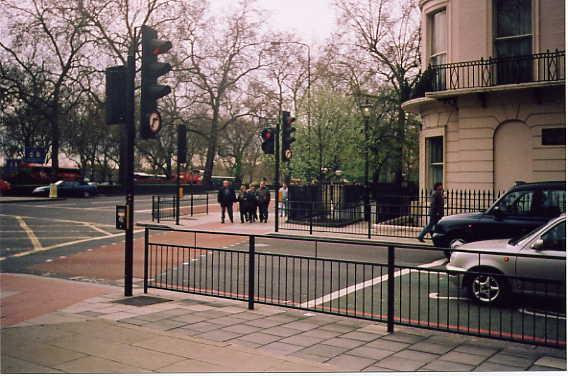 For a couple of years now, there has a been a growing crowd that have become bearish on the UK property market. The bulls cite a number easily disproved fallacies as to why they think property prices will rise well beyond inflation ad infinitum. Shortage of housing, we are an island, high immigration etc etc etc, all of which were cited in the last boom did nothing to stop the bust when it came in the early 90's.
A study of business cycles and a few columns in Excel will quickly dispel the mathematical absurdity of the perpetual boom. Indeed, regional England has been seeing price stagnation, and even falls in some areas. Even Northern Ireland has apparently hit a wall as desperate vendors drop asking prices to shift their overvalued hovels.
Ahh but London, that paragon of all that is coveted in this bourgeois ego infected planet; Harrod's, Covent Garden, Mayfair, the West End and so on, has been stubbornly, defiantly rising in the face of all rationality. There have been two main reasons for this. The UK's favourable tax treatment of non residents has seen billions of pounds pouring in from wealthy foreigners, snapping up all the fashionable real estate. Most recently, this has been coming from the Russian oligarchy. The second factor is the absurdly oversized bonuses financial sector employees have been receiving, due to the recent credit and equities boom.
I mean, what do you do with a Christmas bonus that would make the GDP of a small African nation look like pocket money? Why, buy real estate of course!
We bush economists have been wondering though, how the recent credit market heart attack would effect the City boys. The answer came via the Financial Times:
City bonus fears hit prime market
By Jim Pickard and Sharlene Goff
Published: September 7 2007 20:16 | Last updated: September 8 2007 05:18
Property purchases are coming under pressure in the wealthier London districts after gloomy forecasts for end-of-year City bonuses.
Estate agents have reported some deals falling through, while mortgage brokers have seen a number of active buyers put their property searches on hold, for fear they will not receive the bumper payouts they had hoped for.
House prices in areas popular with City professionals, such as Mayfair, Kensington and Chelsea, rose at their slowest pace for a year last month as the impact of the credit crunch took hold. FULL STORY
While the article states that rises have merely slowed down and no falls recorded, it can't be long before there are MoM falls as the credit crisis plays out.
Now things get interesting. The signs of an impending Austrian bust are everywhere and the ball is in Bernanke's hands, though the general consensus is that he can only provide a rear-gaurd action, giving the smarties enough time to get the hell out of the way.
08 September 2007
Sub-Prime Mess Contained
A leading economist said today that there is no evidence that the sub-prime contagion will spread beyond the stratosphere. Meanwhile, the credit crunch is starting to involve the cheap tat buying public.
Families have been warned of a looming credit drought as banks and building societies stop handing out cards and overdrafts to hard-pressed households
Industry experts have said that lenders are clamping down on debt applications for fear that borrowers default as the economy worsens.It is the latest evidence of how the financial markets crisis is affecting households and follows news that mortgage companies are primed to increase their interest rates, causing more hardship for hundreds of thousands of households due to renew their home loans in the coming months.
Equifax, a company that provides credit checks, said households would find it increasingly difficult to borrow money in the coming months, as lenders started to refuse more and more applications. FULL STORY
I think this will have a quantum effect on retail sales... perhaps even accelerate mortgage defaults. I know plenty of folks who are doing the credit card boogie to make their over-committed ends meet, all the while building more and more debt. Another signal we bush economists take note of.
07 September 2007
Jobs
 So Wall Street economists were expecting ~+115,000 on the NFP number.
Really?
The building industry is hemorrhaging jobs from the great gaping hole in its aorta and I suspect there would be a few real estate broker sending CVs around at the moment too; and the NFP was a shock?
"It's a major shock to the market," said Peter Cardillo, chief market strategist at Avalon Partners. "If the job market continues to weaken, fears of a recession will continue to accelerate, calling into question corporate earnings."You have to wonder about economists. I mean I have an interest in economics and though no formal degree, I would consider myself what would be termed here in Australia as a "bush economist". This is someone who basically has been fucked by not knowing about business cycles before and has learned to "sniff out" when things are starting to get out of whack.
We bush economists have been worried about sub-prime, stretched asset values and rampant malinvestment for a couple of years now while the smirking Wall Street assholes have been bullshitting on about Goldilocks economies.
We have also been wondering how long birth and death models and other such nonsense could disguise the real state of employment. When you get an actual drop of 4,000, it's time for folks to pull out their CVs and polish them up for a potential mass mail out.
But look and the bright side, it's another factor for Uncle Ben to justify a rate cut.
The logic goes: slowing economy => rate cut => bullish => market rally
Yep, Goldilocks rules... along with other fairytales
06 September 2007
So WTF Exactly, is Going On?
Is the Gold upage a harbinger of more uncertain times? What the fuck is going on? B-52s flying around with nukes by "mistake", Russian bomber fleets flying with Jet fighters in puruit?
Holy Crap!!

Holy Crap!!
... and then:US B-52 in nuclear cargo blunderThe US Air Force has launched an investigation after a B-52 bomber flew across the US last week mistakenly loaded with nuclear-armed missiles.

It follows reports in the Army Times that five missiles were unaccounted for during the three-hour flight from North Dakota to Louisiana. FULL STORY.
U.K., Norway Send Jets to Intercept Russian Aircraft (Update2)By Robin Stringer and Sebastian Alison
Sept. 6 (Bloomberg) -- Four U.K. Royal Air Force Tornado jets were launched to intercept eight Russian strategic bombers, the British Ministry of Defence said. Two aircraft from the Norwegian air force also trailed Russia's planes.
The RAF Tornado F3 jet fighters were scrambled early today to intercept the Soviet-era Russian bombers ``which had not entered U.K. airspace,'' the ministry said in an e-mailed statement. The ministry didn't elaborate on how close the RAF aircraft got to the Russian planes. FULL STORY
This is a rather apocalyptic development and could explain gold why gold is getting of its arse and doing something. Renewed Cold war tensions anyone?

Still some ways to go before gold looks like a new trend, but it's been worth paying attention over the last few days.
Eyes wide open for a couple of reasons here.
04 September 2007
Gold Heads Up
 Good old gold! It never ceases to raise the pulses of those enamoured with the yellow metal and trading forums across the globe are abuzz with gold's move today.
One would think that I would be a gold bug, what being of an apocalyptic bent; and sure I have a few obligatory Krugerands etc. It's one of the futures contracts I trade too... why not?
To me it's just another commodity and it's loose inverse relationship to the dollar can be seen in several commodities, but a hedge against a financial apocalypse? Maybe. For sure gold will soar (in dollar terms) if the grenade the financial system has in its hand blows up in its face, but so will other commodities such as silver, copper, oil... maybe even ags and softs. And you can bet your arse I'll being buying with ears pinned back if that happens.
 In the above chart, which has the US dollar index plotted also, you can see the loose inverse correlation. But it is very loose. To me it's not a good hedge for the dollar, really. So I trade it purely on chart action, with a lazy ear on the bullshit fundamentals.
Chart wise, today's move is interesting in that it takes us up to supply line and so waiting to see if it breaks out, but hell's bells, nothing to really have an orgasm over. Certainly if this was a stock chart, it would be mildly of technical interest and in this context it is hardly worth going agog over.
But the thing with gold is that by the time it is really interesting, it good be too late, so building a bit of a position in here makes some sense.
But I'll leave all the salivating to later... possibly
Leads From Japan
Japan is the worlds second largest economy on earth by far and now looks to be leading the world in the race to recession, as reported in The Telegraph.
The last point brings me to the inevitable chart. The Yen has been a useful leading/confirming indicator for movements in the US stock market. The chart below shows the recent action of The JPY/USD futures in candles with the S&P500 in bars and show the clear inverse correlation between the two.
 This begs the question: Does the unwinding of the carry trade have implications for the fortunes of the US stock market, because the is cause the liquidation of stock positions? Or is it the other way 'round: Does the liquidation of stock position cause the repatriation of Yen, resulting in the unwind?
I don't know and would be interested in the answer if anyone has data on this.
In any case, the technical picture in the Yen looks bullish above the trendline. My best technicians guess is that it remains support. (50/50 proposition of course) That would not be good for the indexes.
In any case, Uncle Ben seems reticent about bailing institutions out of malinvested trouble. Could this mean he will hold rates in September? That could well spark off another savage sell-off.
According to Austrian economic theory (as per the videos I posted a couple of days ago), that would be the best course of action, just let it tank, have a speedy liquidation of malinvestment, let the flaky institutions/businesses go to the wall and get on with life after that. I've always thought that too.
Then we could all have the prospect of a "healthy" growing economy again. It is just a shame political imperitives and demands for institutional welfare intervene.
As the latest weak data hits, optimists are now few and far between, writes Ambrose Evans-Pritchard
Japan's economy has slowed sharply over the summer and may now be on the brink of recession, dampening hopes that Asia will buttress world growth as America battles the sub-prime housing crisis.In the latest grim data, Tokyo said wages had fallen for the past eight months in a row. The cumulative fall over the past year to July has been 1.9pc, evidence of how intractable deflation can become once lodged in an economy. Business investment fell 4.9pc, with the pace of decline gathering speed in recent months.
The seemingly endless string of weak data from Japan comes amid mounting concern in Washington that the US economy is starting to buckle, and possibly tipping into a severe slump.
And a couple of other snippets:
*According to Bloomberg reports, the mood at the gathering turned ever blacker as speaker after speaker warned that the economy may be on the cusp of a sudden downward dive.Lots more in the full article.
*While Fed chairman Ben Bernanke said the bank would "act as needed", he cautioned the market not to expect an instant bail-out. "It is not the responsibility of the Federal Reserve to protect lenders and investors from the consequences of their financial decisions."
*Japanese investors have taken a beating on the yen "carry trade", where they borrow in Tokyo to chase higher yields around the world. The Bank for International Settlements said in its quarterly report yesterday that the overall yen carry trade has reached $1,050bn and the Swiss franc sister trade is $678bn.
The last point brings me to the inevitable chart. The Yen has been a useful leading/confirming indicator for movements in the US stock market. The chart below shows the recent action of The JPY/USD futures in candles with the S&P500 in bars and show the clear inverse correlation between the two.
 This begs the question: Does the unwinding of the carry trade have implications for the fortunes of the US stock market, because the is cause the liquidation of stock positions? Or is it the other way 'round: Does the liquidation of stock position cause the repatriation of Yen, resulting in the unwind?
I don't know and would be interested in the answer if anyone has data on this.
In any case, the technical picture in the Yen looks bullish above the trendline. My best technicians guess is that it remains support. (50/50 proposition of course) That would not be good for the indexes.
In any case, Uncle Ben seems reticent about bailing institutions out of malinvested trouble. Could this mean he will hold rates in September? That could well spark off another savage sell-off.
According to Austrian economic theory (as per the videos I posted a couple of days ago), that would be the best course of action, just let it tank, have a speedy liquidation of malinvestment, let the flaky institutions/businesses go to the wall and get on with life after that. I've always thought that too.
Then we could all have the prospect of a "healthy" growing economy again. It is just a shame political imperitives and demands for institutional welfare intervene.
03 September 2007
September Divinations
Always a useless exercise, predicting the future. However armed with a few statistics, I guess we can make a better "guess".
Anyone who has read CNBC over the weekend will have had the "heads up" that September is statistically the worst month of the year, set out in table form from their site:
 Most have October locked in as the scariest month because of the few crashes that have occuredin October, but in actual fact, in most years October is up. Apart from those crashes, it's usually a good month. It's September that has quietly put in the hard yards as the crappiest month of the year.
For those who like a more graphical format, here is a bar chart I found at The Ducster's site:

Add to these statistical probabilities, the problems in the credit markets... yeah, yeah I know it's gone quiet on that front. It's very quiet, almost too quiet. I don't believe the problems have gone away or have been resolved, just a dearth of news on the subject; we don't really know what's going on deep in the bowels of financial institutions. According to my few little contacts in the institutions, they themselves don't know the extent of the problem, so everybody is keeping mum.
If the news breaks the surface the surface again, it could be truly fugly.
On the other hand, there is the possibility of the morally hazardous rate cut. In this interest rate obsessed stock market where rates are seemingly the only important fundamental, that could send the the permabulls into a muck lather buying frenzy.
I guess it all boils down to what corpses float to the surface in the next two or three weeks, but I'd be less surprised by new lows than new highs... not that I'd be surprised by new highs. There are still plenty willing to ignore the fact that we are likely to be moving into a credit crunched period of the cycle.
Austrian bust anyone?
Anyone who has read CNBC over the weekend will have had the "heads up" that September is statistically the worst month of the year, set out in table form from their site:
 Most have October locked in as the scariest month because of the few crashes that have occuredin October, but in actual fact, in most years October is up. Apart from those crashes, it's usually a good month. It's September that has quietly put in the hard yards as the crappiest month of the year.
For those who like a more graphical format, here is a bar chart I found at The Ducster's site:
If the news breaks the surface the surface again, it could be truly fugly.
On the other hand, there is the possibility of the morally hazardous rate cut. In this interest rate obsessed stock market where rates are seemingly the only important fundamental, that could send the the permabulls into a muck lather buying frenzy.
I guess it all boils down to what corpses float to the surface in the next two or three weeks, but I'd be less surprised by new lows than new highs... not that I'd be surprised by new highs. There are still plenty willing to ignore the fact that we are likely to be moving into a credit crunched period of the cycle.
Austrian bust anyone?
02 September 2007
Lessons in Economics
 Here is an excellent series of lectures on the Economic cycle from the Austrian perspective. (My favoured model)
Business Cycles, Part 1 of 4 - Introduction, Prof. Krassimir Petrov
Business Cycles, Part 2 of 4 - Business Cycle Indicators, Prof. Krassimir Petrov
Business Cycles, Part 3 of 4 - The Austrian Boom, Prof. Krassimir Petrov
BusinessCycles, Part 4 of 4 - The Austrian Bust, Prof. Krassimir Petrov
Each is over an hour and essential viewing for anyone interested in economic cycles.
Photo - Ludwig Von Mises
Subscribe to:
Posts (Atom)